
English| EUR
Suggested for you
More currencies
Choose a language
Zagora sits at the edge of the Draa Valley, where the same day can swing from fierce sun to a wind that cuts through a thin jacket. Clothing here is equipment, not styling. This what to wear in the sahara desert morocco guide sets out the fabrics, coverage and footwear that actually work on the erg.
Quick answer
Wear loose, long-sleeved cotton or linen in light colours, full-length trousers, closed shoes, and a scarf or chèche for head and neck cover, with a warm mid-layer for after sunset. Access to the Zagora dunes is public and free at 0 MAD, so the only real barrier is arriving underdressed for a place that is 40°C at noon and chilly by midnight.
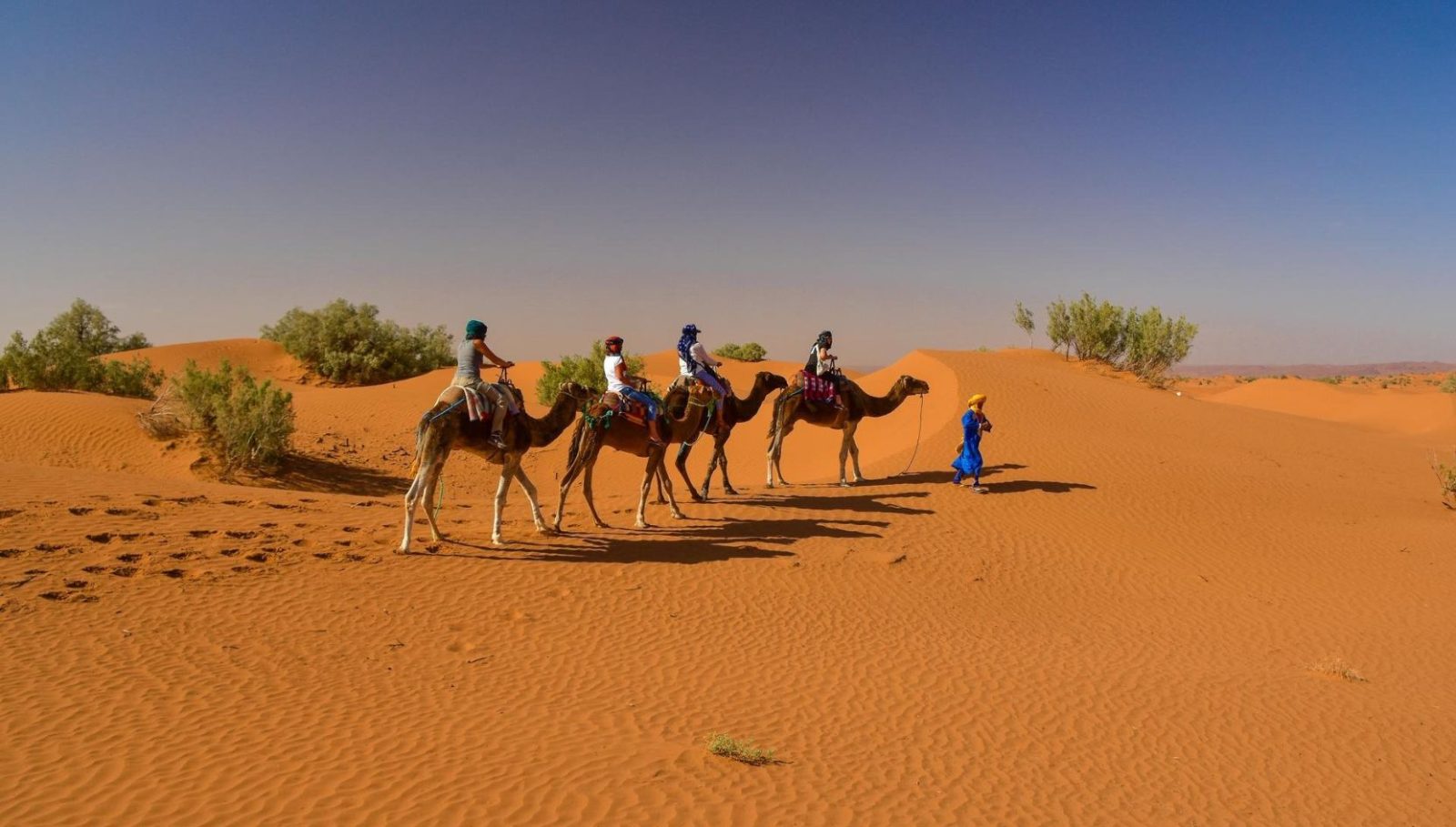
The Draa Valley records some of the widest daily temperature swings in Morocco, and travellers routinely pack for one half of that range. A single Zagora day can move roughly thirty degrees between the midday erg and the small hours in a bivouac. Anyone researching what to wear in the sahara desert morocco is really solving a two-climate problem inside twenty-four hours. The traditional answer is already visible on the road to M'Hamid. Local men wear the loose blue or white djellaba; the chèche, a long cotton head wrap, covers scalp, neck and face. Neither is decorative. Loose weave over covered skin traps a layer of cooler air, blocks direct radiation and slows sweat loss far better than bare arms. Cotton and linen breathe; synthetics trap heat and hold odour. Pale colours reflect. Dark denim is the single most common mistake on a Sahara desert tour from Marrakech, closely followed by open sandals, which fill with sand within minutes of the first dune ridge. Footwear deserves particular thought. Sand in the Zagora erg is fine and abrasive, and camel trekking puts the inner calf against a rough saddle blanket for an hour or more. Closed trainers or light boots with ankle coverage, worn with proper socks, prevent both grit burn and stirrup chafe. Long trousers matter for the same reason, and they also handle the practical business of sitting cross-legged on carpets in a nomad tent. After sunset the desert reverses. Clear skies and bare sand release heat quickly, and the Draa-Tafilalet nights fall cold even in August. A fleece, a packable down layer, or a wool jumper turns a Zagora night sky from an endurance test into the reason people come. Sunglasses, high-factor sunscreen and lip balm complete the kit; the glare off pale sand reaches the face from below as well as above. Read this what to wear in the sahara desert morocco advice as a system rather than a list: cover, breathe, layer, and add head protection. The dunes at Zagora Desert, Draa-Tafilalet, Morocco sit on open public land, so there is no cloakroom, no shade structure and no chance to buy a forgotten jacket at the sand's edge. What travels in the bag from Marrakech is what will be worn.
“Clothing in the Zagora erg is equipment, not styling — cover, breathe, layer, and cover the head.”
Pack for a climate that swings from strong sun to cold desert nights, with sand and wind in between.
Zagora sits in a conservative rural region of Draa-Tafilalet where Berber and Arab families live and work alongside visiting groups. Dressing modestly and asking before photographing people signals respect and shapes how you are received in camps and villages.
The best time to visit the Zagora Desert is during the shoulder seasons of spring and autumn, when moderate temperatures facilitate easier layering for significant diurnal temperature swings. Aim to arrive during the best arrival window of 06:00–10:00 to capitalize on cooler temperatures and superior light for photography.
Highs 25°C–32°C; cool nights
Transition months require versatile layers for warm days and chilly evenings.
Highs 25°C–30°C; mild nights
Similar to spring, these months offer stable weather ideal for desert excursions.
Highs 18°C–22°C; cold nights
Daytime activity is comfortable, but nights drop significantly, requiring thermal base layers.
Highs 40°C+; warm nights
Extreme heat makes midday travel difficult; protection from direct sun is essential.
Verdict: The most favorable conditions for travel occur between March to May or September to November, arriving between 06:00–10:00 to avoid extreme midday heat.
The Zagora Desert is located in the Draa-Tafilalet region of Morocco. Most travelers reach this destination via a long drive from Marrakech crossing the Atlas Mountains.
Route N9 from Marrakech to Zagora
Supratours or CTM from Marrakech to Zagora
The best arrival window is 06:00–10:00 to avoid extreme midday heat and take advantage of better lighting for desert photography. Public access to the Zagora Desert is 0 MAD, with no gate or entrance fee.
The Zagora Desert is accessible to visitors at all times throughout the week. You may enter the area freely regardless of the day.
Everything you need to know about what to wear in the sahara desert morocco
For desert excursions, prioritize lightweight, breathable fabrics like linen or cotton to stay cool under the sun. You should also pack a light scarf to protect your face from wind and sand while exploring. Knowing what to wear in the Sahara Desert Morocco ensures you remain comfortable during long days in the dunes.
While the desert is remote, modest clothing is appreciated in local communities. Keep shoulders and knees covered to respect cultural norms during your travels. When considering what to wear in the Sahara Desert Morocco, balancing functionality with modesty is the most effective approach.
The best arrival window is 06:00–10:00 to avoid extreme midday heat and secure optimal natural light for your photos. Planning your arrival during these hours allows for a more pleasant experience in the dunes. Adjusting your clothing layers is easier during these cooler morning hours.
There is 0 MAD entrance fee as this is a public access area with no gates. You do not need to budget for admission costs when planning your trip to the Zagora Desert. Resources are better spent on proper sun protection and hydration gear.
When preparing for your trip, choose loose-fitting layers that can be adjusted as temperatures shift throughout the day. Sturdy, closed-toe footwear is essential for walking on sand and rocky terrain. This is a primary factor regarding what to wear in the Sahara Desert Morocco for a safe experience.
Yes, temperatures fluctuate significantly between day and night, even in summer. Bring a warm layer for the evening, as desert temperatures drop rapidly once the sun sets. Regardless of the season, packing versatile pieces is the key to desert readiness.